Kesselschlacht Studios presents
Herbstnebel
The Battle for the West Wall, 1944–45. Command the German offensive into the Ardennes or the American and British defence, battalion by battalion, from the first barrage on 16 December to the last German withdrawal in January.

The map
12,000 one-mile hexes. Every village, river and road of 1944.
Bastogne, Houffalize and Wiltz, from the Herbstnebel map: built from the 1944 US and German map sheets.
- Scale
- 1 mileper hex, flat-top grid
- Units
- Battalionsplus independent companies
- Turn
- 1–6 hours6-hour turns for the campaigns; 3 or 1 hour for the battles
- Map
- 12,402 hexesArdennes to Aachen and the Meuse
- Period
- 16 Dec – 31 Jan1944–45
- Counters
- About 1,800German and Allied
What makes it different
The war on the roads
The Ardennes was won and lost at crossroads. Herbstnebel is built around the things that decided it.
Minutes, not movement points
Every unit has a clock, not a points allowance. A six-hour turn is 360 minutes; a panzer column can cover forty miles of open road by day, while a rifle battalion crossing wooded hills at night may make two. Unused minutes carry over, and the cost of each hex depends on the road, the terrain, the weather, the light and the traffic ahead of you.
Fuel, supply and traffic
Fuel runs out, supply lines get cut, and roads jam when two divisions use them at once. The Germans have to plan their drive to the Meuse around the fuel they actually have.
Encirclement that counts
A surrounded battalion loses more and may collapse or surrender. Close a pocket and you can destroy a formation; leave a gap and it gets away. Losses in men and equipment are tracked separately.
Reserves that react
Put a unit in reserve and it waits. When an enemy column comes within five miles it moves to block the road, and can counterattack at once. Give it standing orders — Hold, Block, or Block and Counterattack.
Fog of war
You see what your units can see. Enemy units are contacts until identified, and old reports go stale.
An opponent that plans like a staff
The computer opponent plans from army down to battalion. It sets an objective for each corps, concentrates battalions for an attack, keeps reserves back to meet a breakthrough and pulls its artillery behind the front. Four difficulty levels run from Recruit to General.
Choose your clock
Play six-hour turns for a fast-moving campaign, or switch to three-hour or one-hour turns in Game Options when you want every company move to count. The smaller battles are played in three-hour or one-hour turns. Combat and movement rescale automatically.
Bridges and rivers
Engineers prepare bridges for demolition and blow them in the enemy's face — or fail to. Assault crossings, bridging columns and fords decide where an offensive can go.
Orders that last
Give a unit a MOVE TO order and it keeps driving toward its objective turn after turn, until it arrives or runs into trouble. Command a corps without moving every counter by hand.
At the command table
Right-click, and give the order
Right-click any unit and a menu shows everything that unit can do this turn — and nothing it can't. Orders it can't carry out are greyed out, with the reason: out of fuel, out of command range, pinned in an enemy zone of control.
- Plot a route and see the minutes it will take before you commit, hex by hex.
- See the odds and the likely losses of an attack before you launch it.
- Switch a column to Road March, dig in, go into reserve or set standing orders in one click.
- Hand a unit a multi-turn MOVE TO objective and let it drive.
Illustration — final interface in development.
The map
The Ardennes as it was in December 1944
A single seamless map of 12,402 one-mile hexes from the Eifel to the Meuse and north to Aachen, rendered to look like an aerial photograph rather than a board game. Forests, ridges, river valleys and every village are where they were in 1944.
Roads and railways follow the 1944 network, not today's motorways. Rivers wind naturally through the hexes. Snow, mud and the hillshade of the Eifel ridges are painted in, so you can read the ground the way a commander read his map.
Built on real coordinates. The map is tied to the real-world UTM grid, so every hex centre sits on an actual latitude and longitude, and the artwork is drawn at 11 metres per pixel. Forests, roads, railways, rivers and villages were traced hex by hex from the wartime topographic map sheets. Where no wartime sheet survives for a corner of the map, modern survey data fills the gap with post-war roads removed, and every hex records which source it came from. The aim is a map as accurate as the surviving maps allow.
Scenarios
From one crossroads to the whole offensive
- Skyline Drive
The tutorial, 16–18 December. Three German divisions against the 110th Infantry's strongpoints on the ridge road above the Our, from Marnach to Clervaux.
22 turns · 3 h - Kampfgruppe Peiper
16–24 December. The spearhead of 1. SS-Panzer-Division races for the Meuse bridges — and runs out of fuel and road at La Gleize.
68 turns · 3 h - St. Vith
The fortified goose egg, 16–23 December. The 106th Division in the Schnee Eifel, the 7th Armored on the road from the north.
1-hour turns - Bastogne
The siege, 19–26 December. Hold the town with the 101st Airborne and Combat Command B, or take it before the 4th Armored breaks through.
62 turns · 3 h - Manhay
20–27 December. "Das Reich" against the 3rd Armored and 82nd Airborne for Parker's Crossroads and the road to Liège through the centre of the salient.
62 turns · 3 h - Patton's Relief Drive
22–26 December. Third Army turns north through the 5th Parachute Division to reach Bastogne.
38 turns · 3 h - Wacht am Rhein
The Historical Grand Campaign, 16 December to 31 January, with the historical schedule of reinforcements and transfers.
187 turns · 6 h - The Small Solution
Von Rundstedt's alternative plan: instead of the drive to Antwerp, a double envelopment of the American forces around Aachen, with 5. Panzer-Armee swung north as the right wing. A what-if campaign, 16 December to 31 January.
187 turns · 6 h
Eight scenarios and campaigns, from a three-day tutorial to the whole offensive. Turn counts at each scenario's standard turn length. More are in preparation.
Screenshots
Six scenarios, one map
New screens from the current pre-release build, taken from different scenarios. Select an image to see it full size.
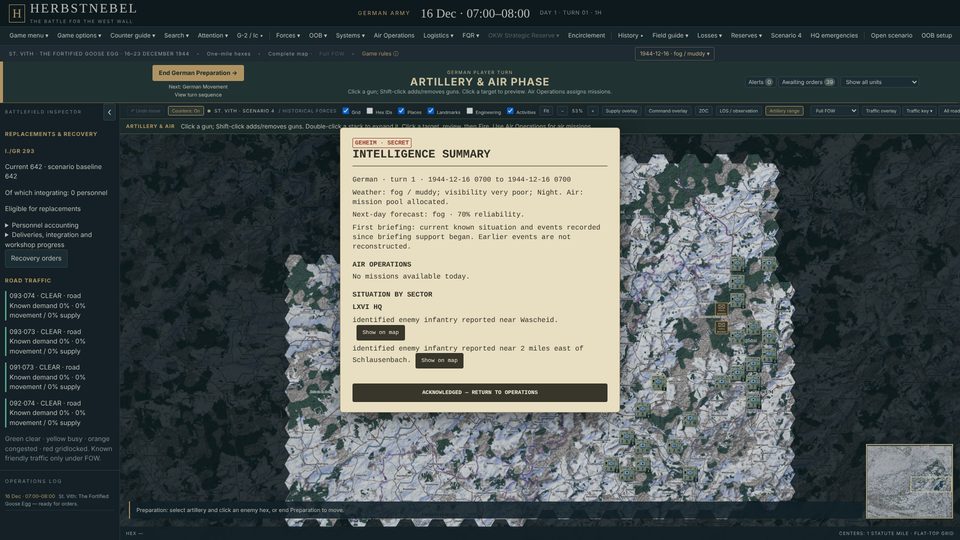
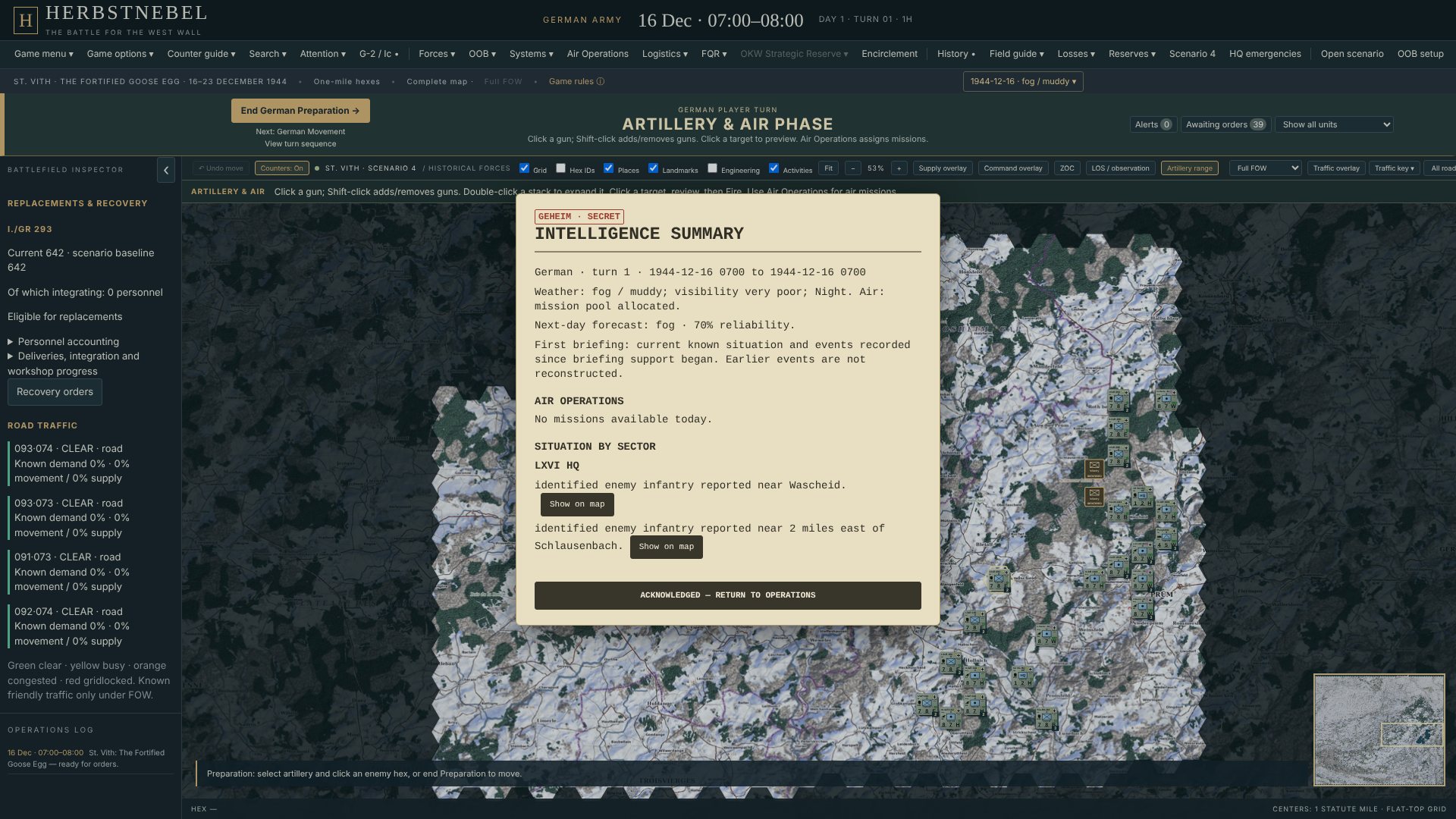
The morning intelligence summary · St. Vith, 16 Dec 1944, 07:00Pre-release build 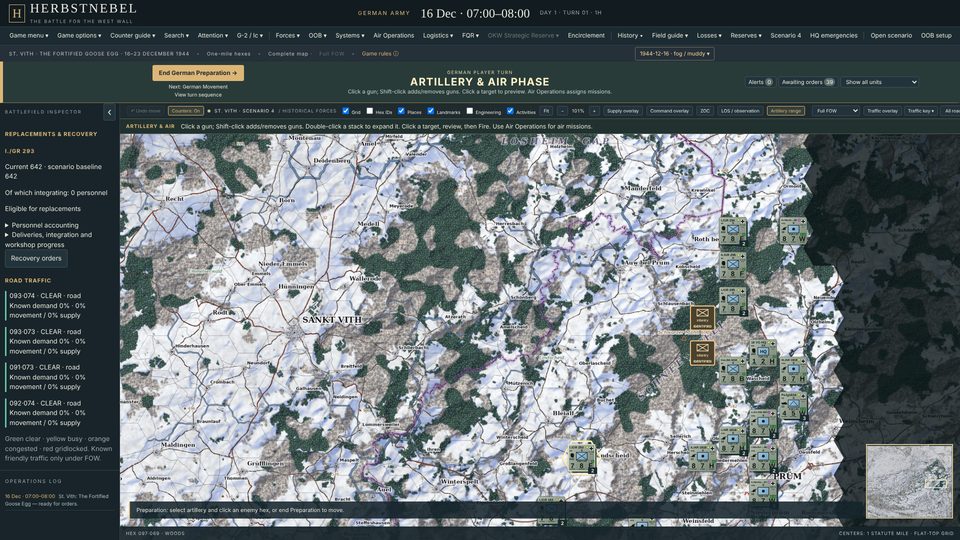
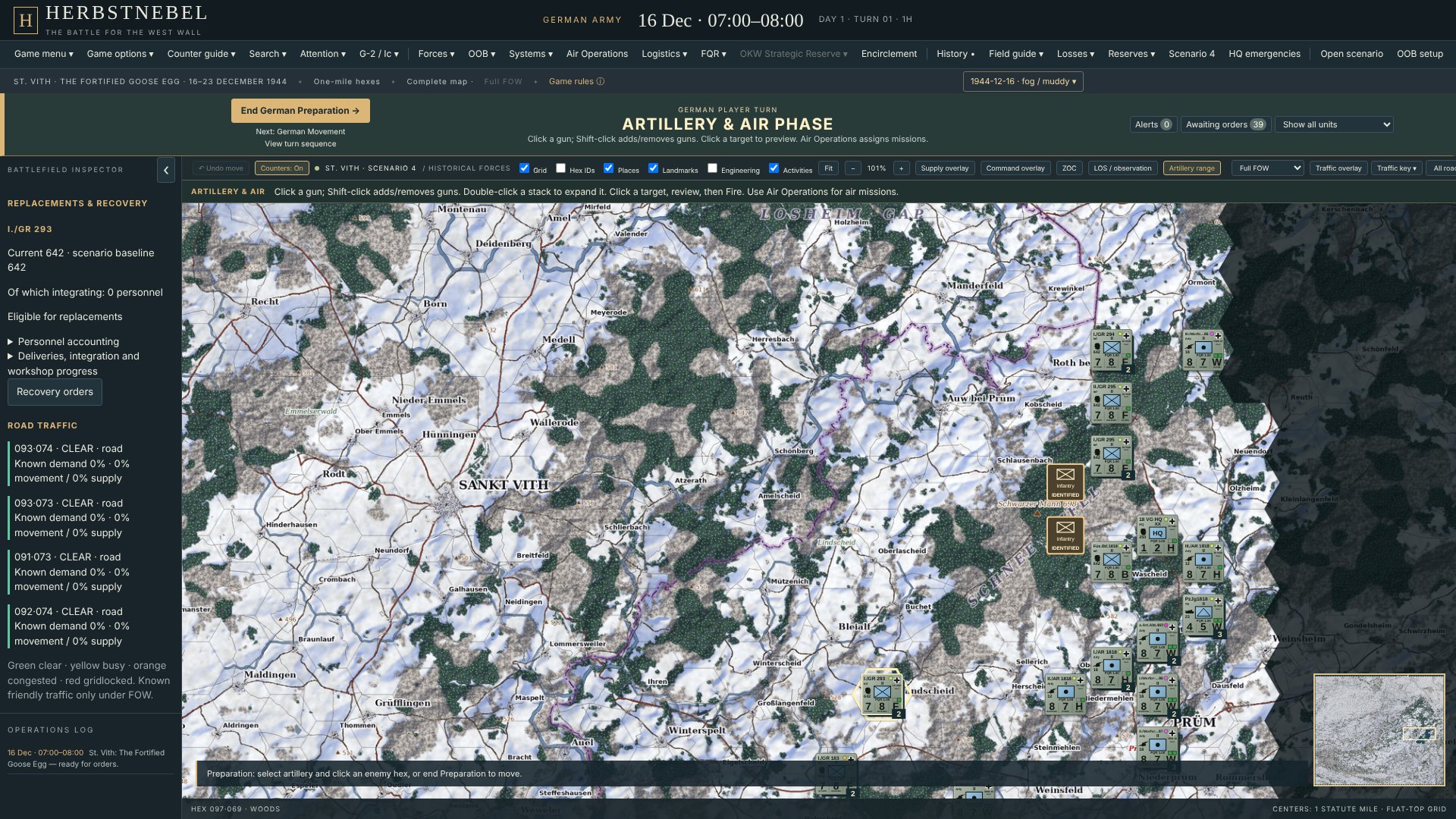
St. Vith: The Fortified Goose Egg · 18. Volksgrenadier-Division opens the attackPre-release build 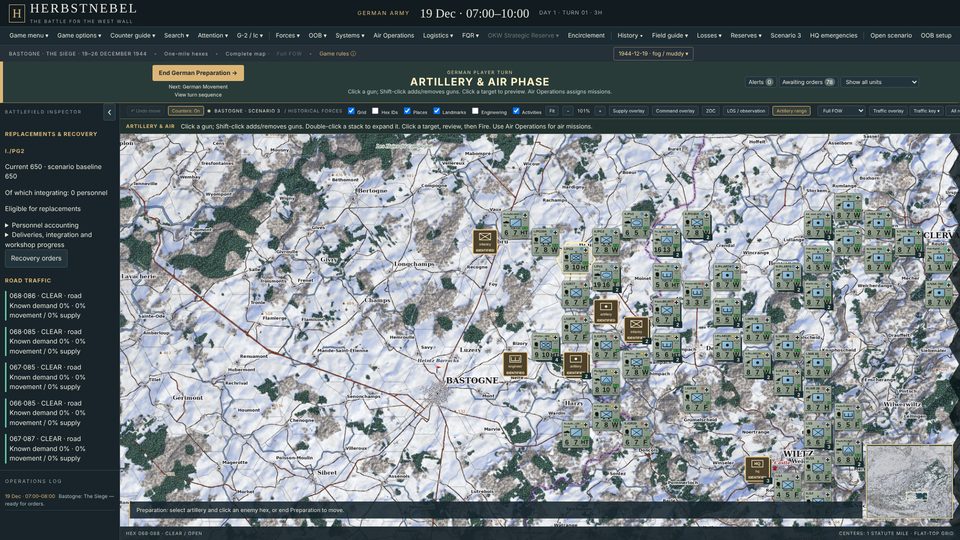
Bastogne: The Siege · 19 Dec 1944, German forces close from the eastPre-release build 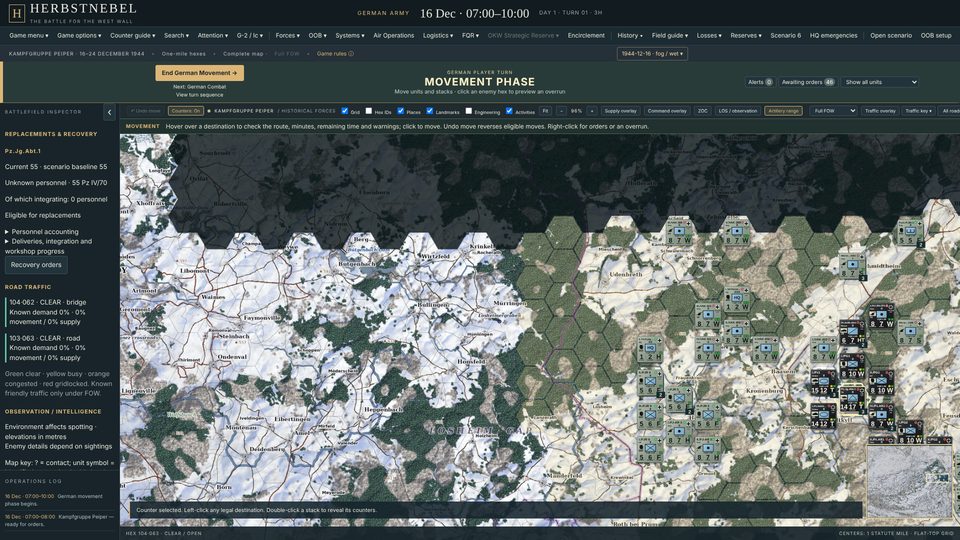
Kampfgruppe Peiper · movement phase, reachable hexes shownPre-release build 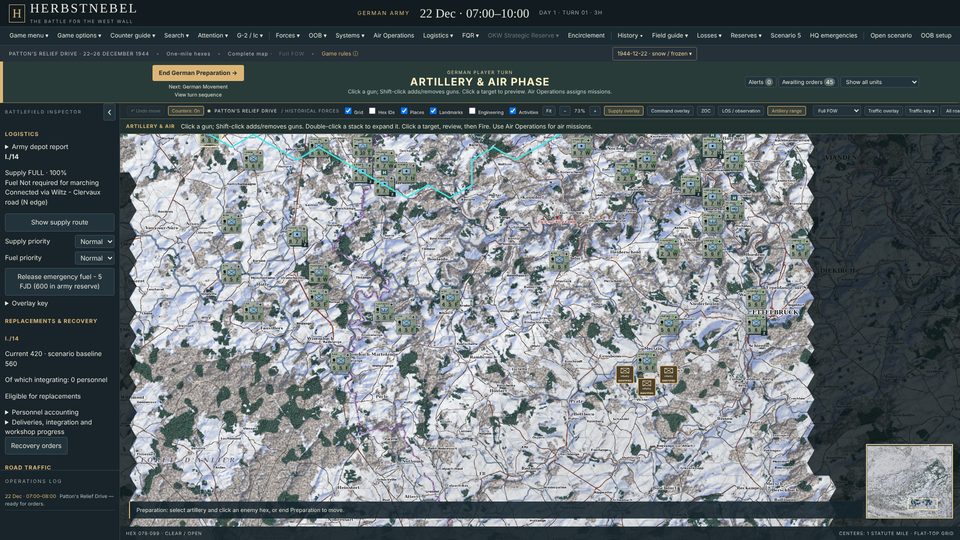
Patton’s Relief Drive · supply overlay, 22 Dec 1944Pre-release build 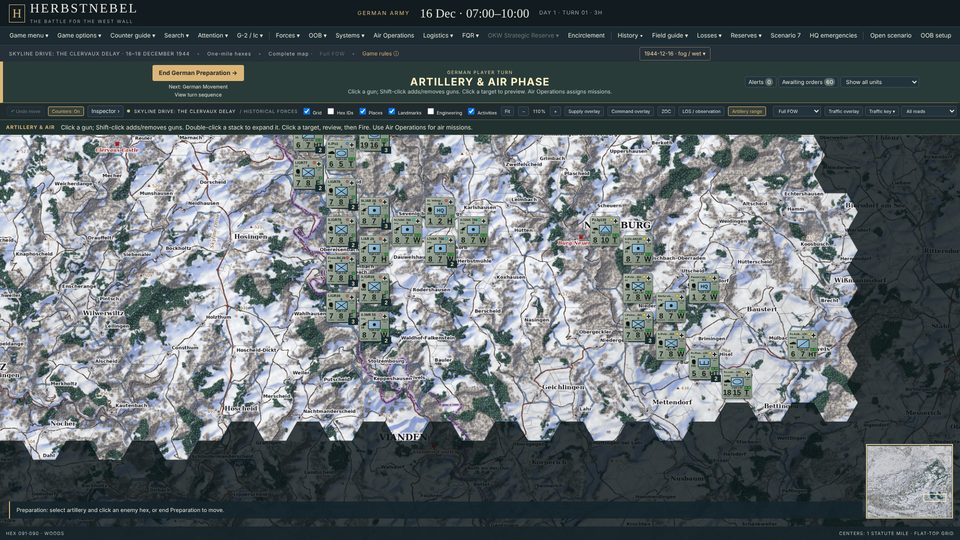
Skyline Drive: The Clervaux Delay · the tutorial scenarioPre-release build
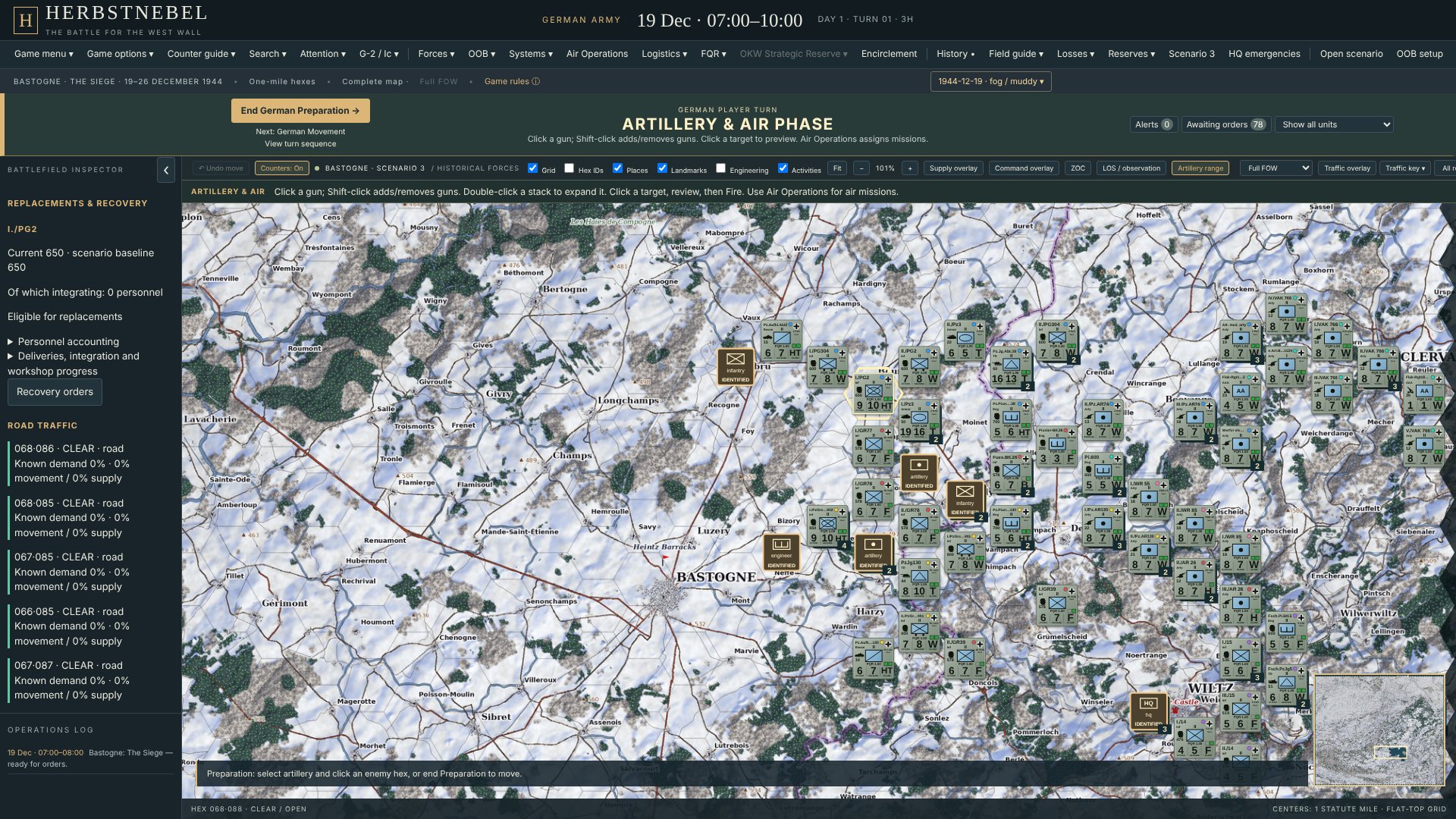
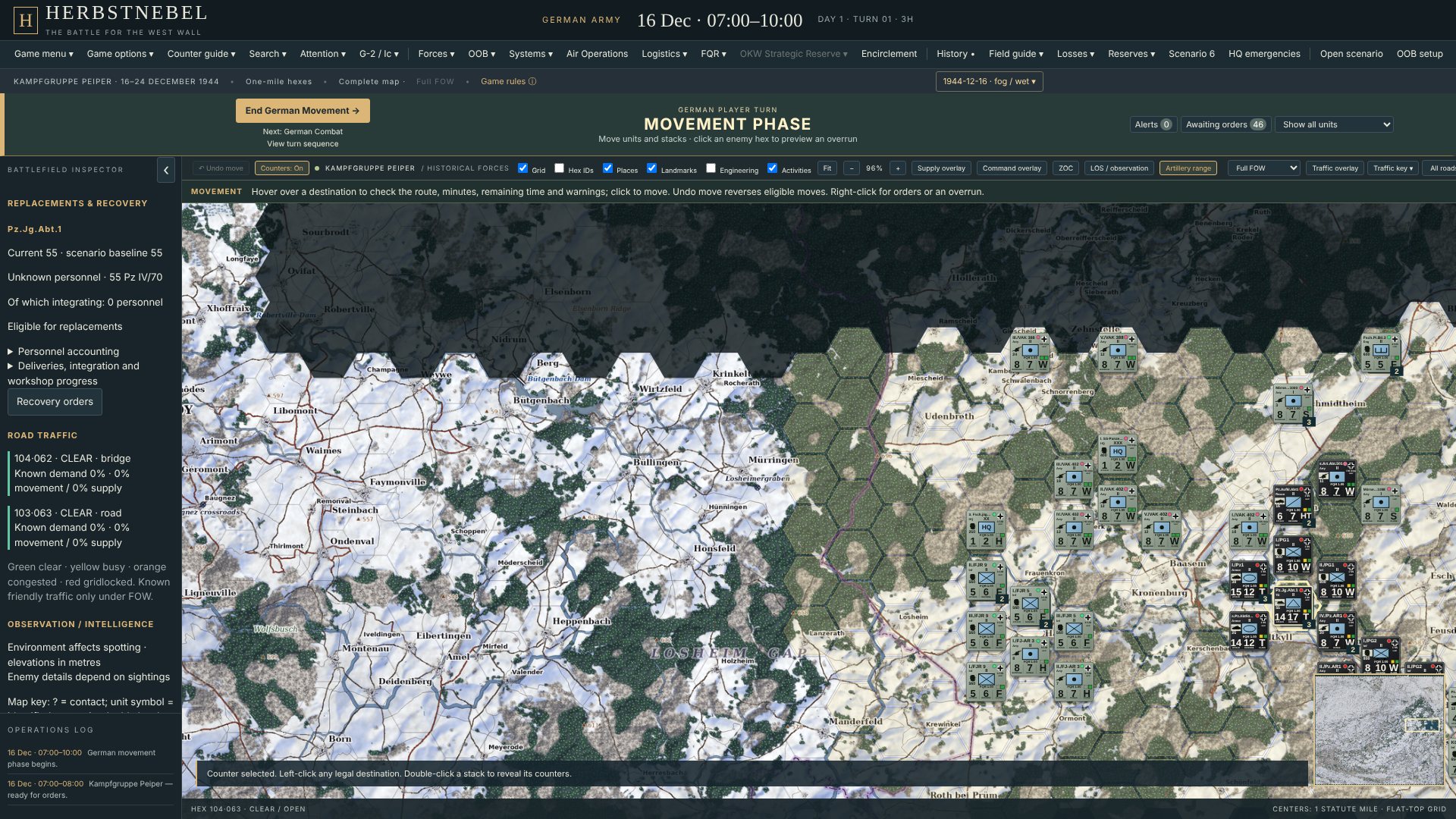
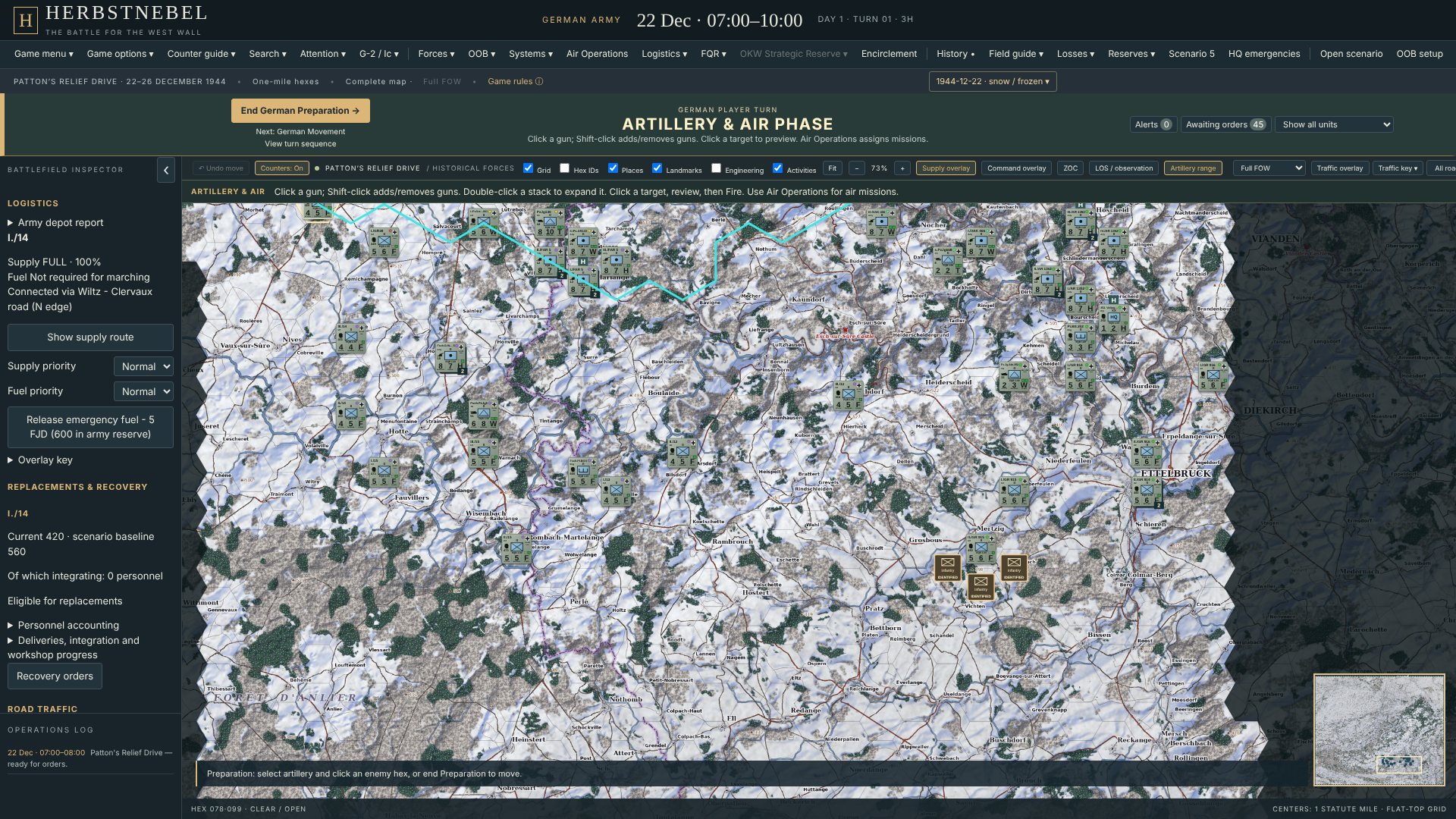
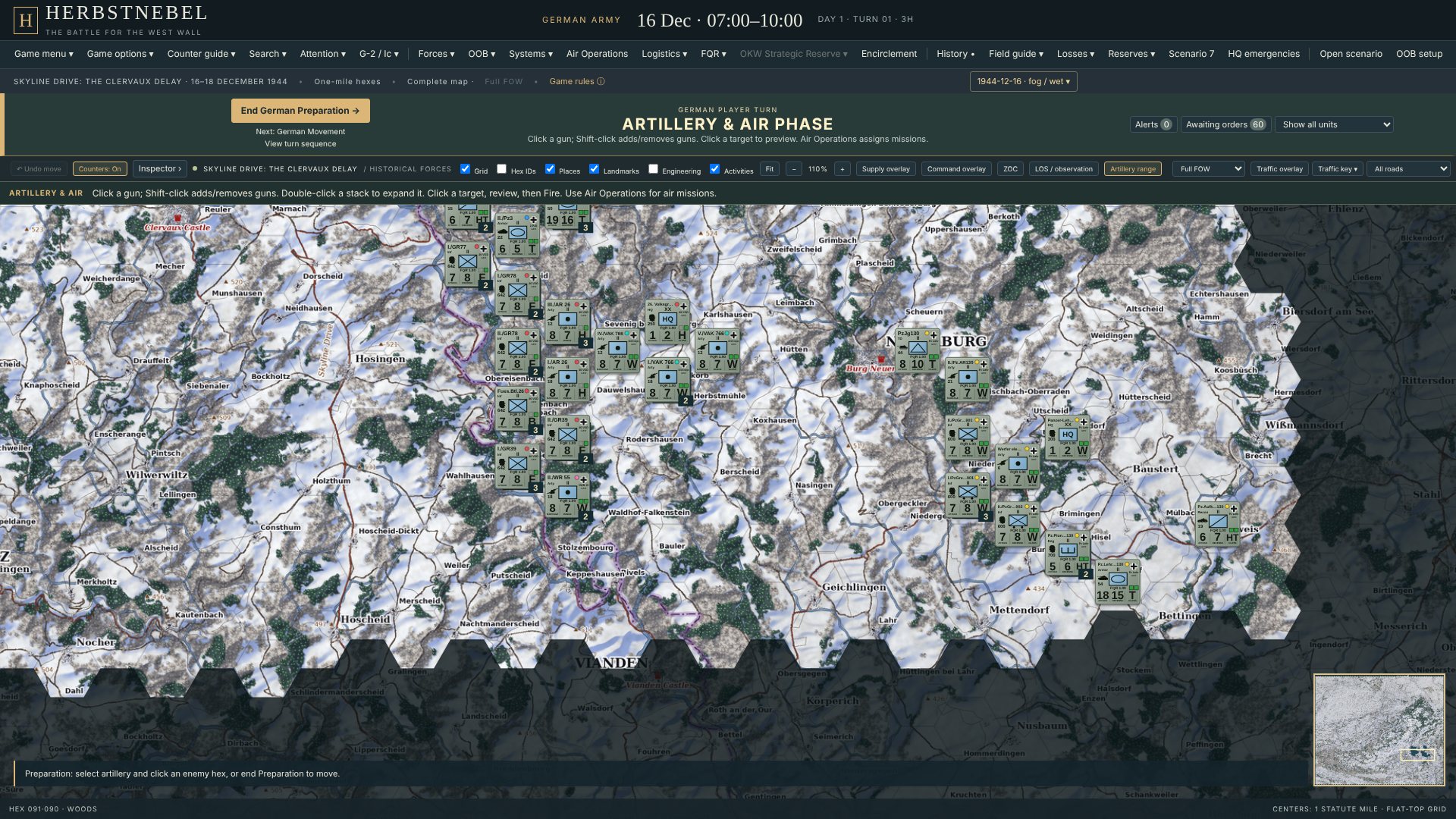
Pre-release build, October 2026. The interface may still change before release.
In action
Announcement trailer
Herbstnebel in motion: the map, the counters and the fighting for the Ardennes, with an original score. A full gameplay walkthrough is being recorded now; sign up below and we'll send it to you when it's out.
Built from the sources
Researched, graded, cited
German order of battle from Trevor Dupuy's Ardennes Campaign Simulation Data Base, Hermann Jung and George Nafziger, with every battalion's strength and its source.
American positions day by day from US Army records and the Twelfth Army Group situation maps.
The map from the wartime Belgian, Luxembourg and German topographic sheets, registered to real UTM coordinates, with a recorded source for every hex.
Hugh M. Cole's The Ardennes: Battle of the Bulge for the course of the fighting, checked against the German side.
Counter guide
Every number on the counter, explained
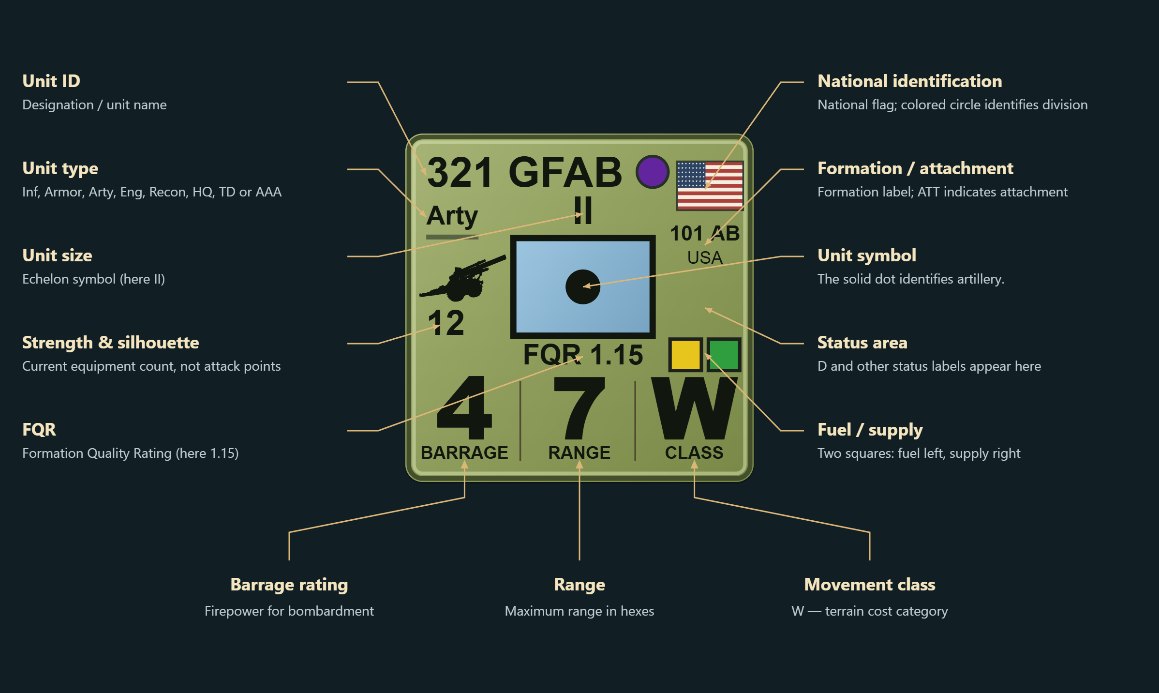
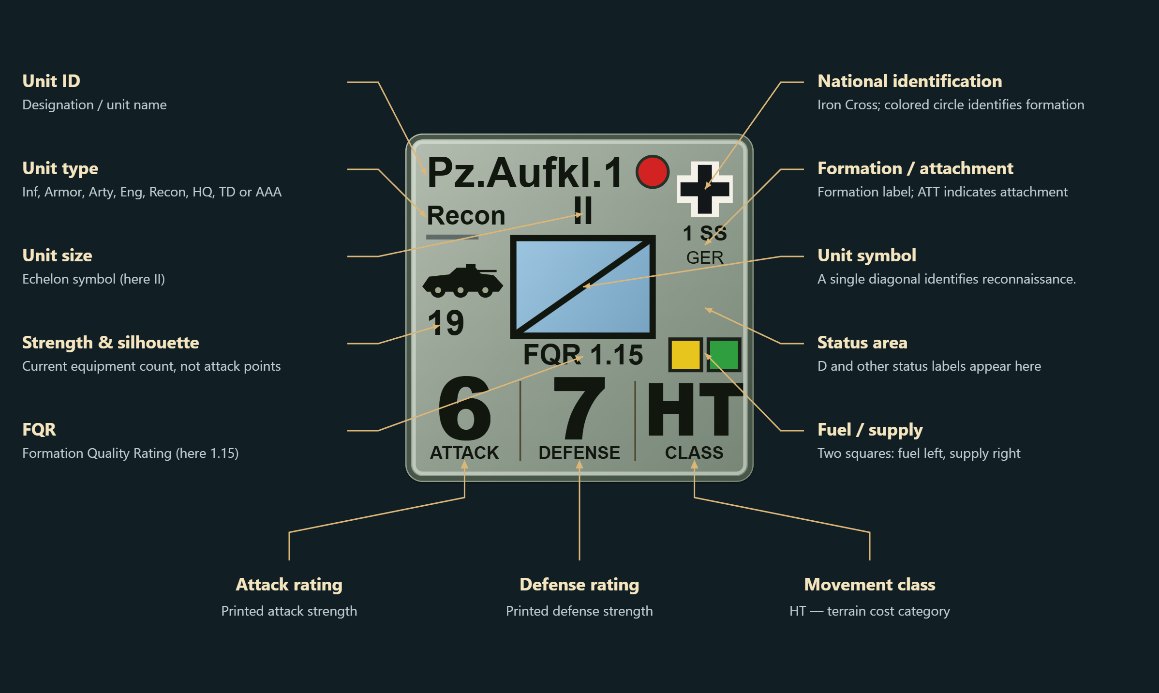
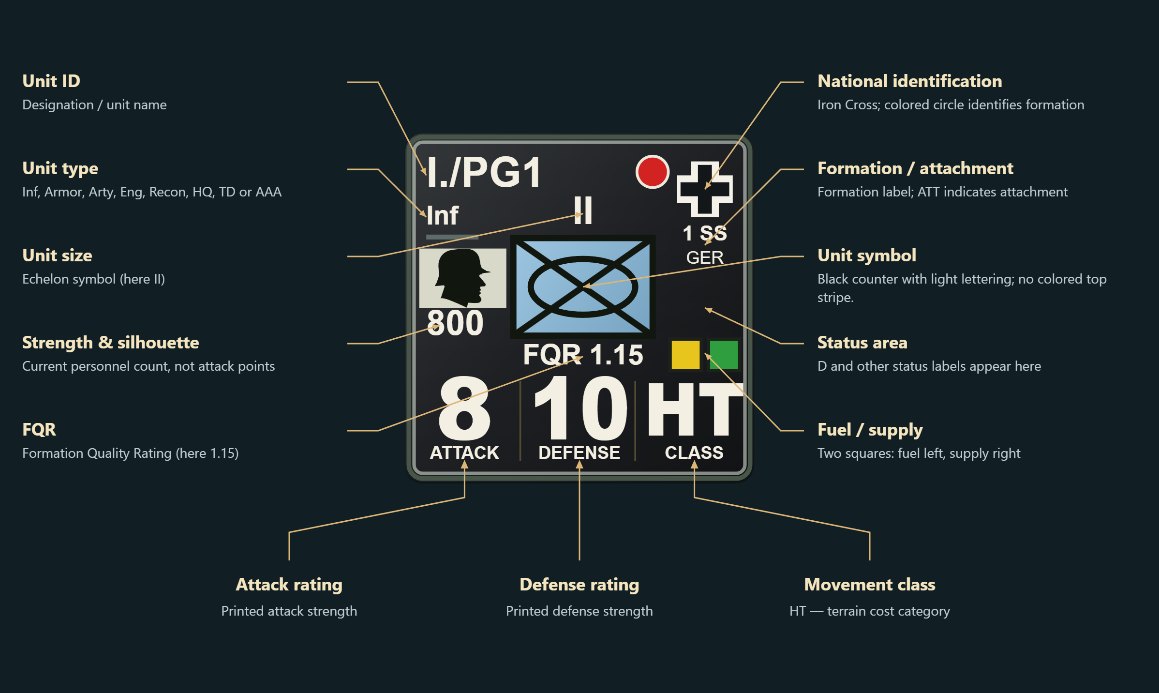
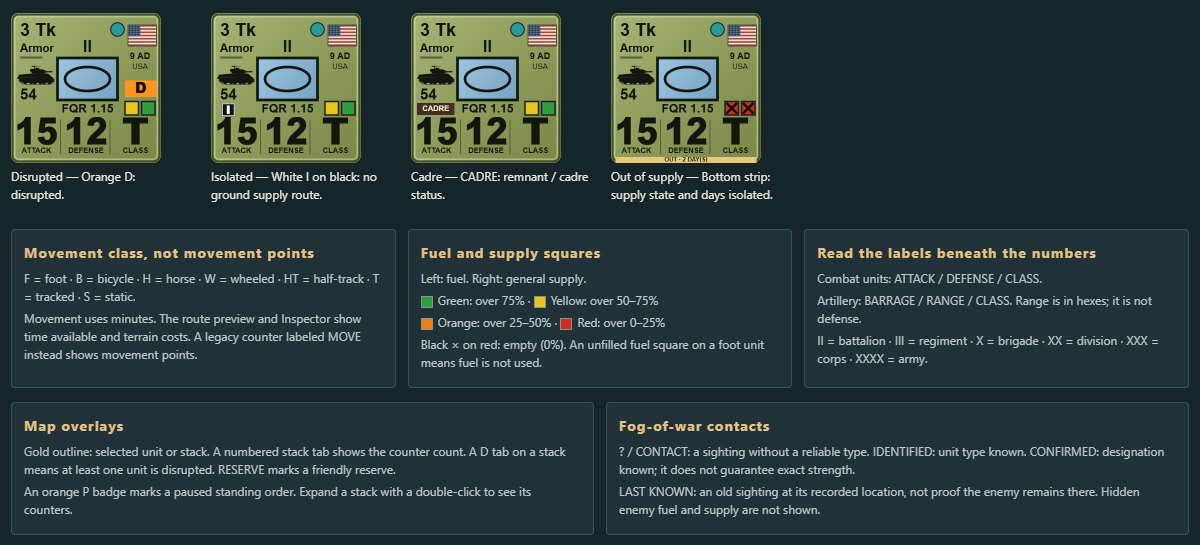
Like the player aid in a boxed board game, the built-in counter guide takes every kind of unit apart: its identity and formation, strength in men or equipment, Formation Quality Rating, fuel and supply, and the three numbers along the bottom. It is drawn by the same code that draws the counters on the map, so what you learn there is exactly what you see in play.
Dispatches
Be there on day one
Get the gameplay video, development diaries and the release announcement for Herbstnebel.
One email a month at most. Unsubscribe with one click.